
💌 In my newsletters, I am share with you tips on how I’ve lost almost 30 POUNDS and the recipes I used to get there. I also send out the weekly sales, steals, and deals. And it’s completely FREE. Sign up below!
And it’s completely FREE..sign up HERE!
WATCH on YOUTUBE!
If you’ve ever walked through the streets of Italy, France, or Spain, you may have noticed something.
The women don’t necessarily look younger.
They look…better.
They move with confidence. They have energy. Their posture is beautiful. Their skin has a healthy glow. They appear relaxed, vibrant, and stylish—without looking like they tried too hard.
And while plenty of people credit European beauty products, French pharmacy finds, or expensive skincare routines, I believe the real secret begins somewhere entirely different.
It begins with the way they live.
The way they eat.
The way they move.
The way they rest.
The way they gather.
And even the way they dress.
In many Old World European cultures, wellness and style aren’t treated as two separate things. They are deeply intertwined.
Because when your body feels better, you naturally carry yourself differently.
You stand a little taller.
You move with greater ease.
You have more energy.
There’s real vitality in your eyes.
And those are things you simply can’t buy in a boutique.
This idea has become the foundation of everything I teach:
Wellness is the foundation. Style is the expression.
Why European Wellness Habits Matter in Midlife
Women in Europe experience menopause too.
They experience hormonal changes, shifts in metabolism, changes in body composition, and many of the same challenges women face in North America.
But biology is only part of the story.
Lifestyle matters.
Culture matters.
And the small choices we make every day matter.
The way we eat, move, rest, socialize, spend time outdoors, and structure our days can influence how we feel as we age—and how we show up in the world.
Of course, Europe is an incredibly diverse continent with many different countries, cultures, and lifestyles. When I talk about “European women,” I’m primarily referring to the Old World European and Mediterranean cultures I’ve spent years studying—particularly Italy, France, and Spain.
I had the opportunity to complete part of my undergraduate studies in Madrid, Spain, and I experienced many of these traditions firsthand.
Not every woman in these countries lives this way, and healthy and unhealthy lifestyles exist everywhere. But certain cultural habits appear again and again—and I believe they are worth paying attention to.
Because the glow we admire isn’t always coming from a product.
Sometimes it comes from the pace of life.
The evening walks.
The leisurely meals.
The time spent outdoors.
The connection with family and community.
The ability to find beauty and pleasure in ordinary moments.
As a Certified Nutrition Coach and Certified Gut Health Specialist, I’ve helped hundreds of women make the stubborn scale finally move, reduce stubborn midsection weight, and banish the belly by focusing on simple, sustainable nutrition and wellness habits.
If you feel like you’re doing everything right but still aren’t seeing results, send me an email. I’d love to learn more about your goals and customize a wellness plan that fits your body, lifestyle, and needs.
Here are ten Old World European wellness habits we can incorporate into our own lives—no passport required.
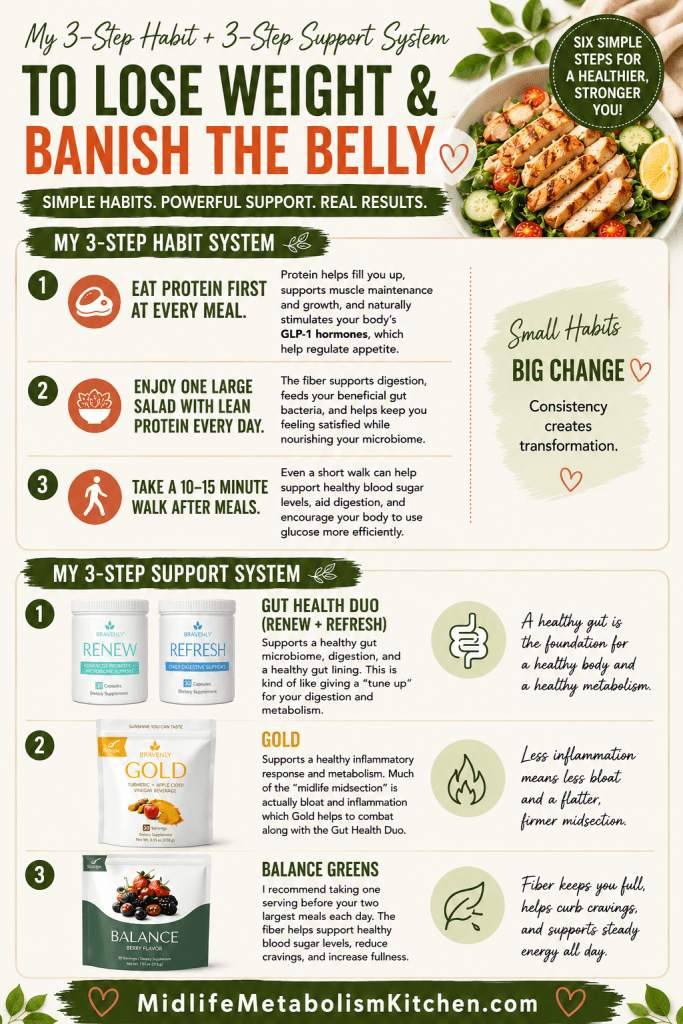
🪴Gut Health Duo Discounted BUNDLED with Balance Greens – https://midlifeposhcloset.bravenlyglobal.com/everyday-wellness-trio/
🫖 GOLD for Skin + Inflammation + Metabolism: https://shop.bydesign.com/Bravenly/#/shop/detail/GOLD/from/B8772899
Midlife Metabolism Kitchen Facebook Group: https://www.facebook.com/groups/1392234382804864
1. Slow Down and Stop Rushing Through Life
One of the biggest differences I notice in Old World Europe is the pace of everyday life.
People walk.
They linger.
They sit.
They talk.
They don’t always appear to be racing toward the next thing.
Meanwhile, many of us in North America live in permanent “go mode.”
We wake up and immediately check our phones. We rush through our coffee, meals, work, errands, and responsibilities. Then we wonder why we feel exhausted and disconnected from ourselves.
Old World European culture reminds us of something important:
Slowing down isn’t laziness. Slowing down can be part of staying well.
You don’t have to move to Italy or completely redesign your life. Start by creating small moments when you aren’t rushing.
Drink your morning coffee without scrolling.
Sit outside for ten minutes.
Take the long way through the garden.
Give yourself permission to enjoy a moment without trying to make it productive.
2. Treat Meals as More Than Food
In many Old World European cultures, meals aren’t something to squeeze between emails.
They are an experience.
A pause.
A moment of nourishment and connection.
Even when the food is simple, the meal is treated with care.
Compare that with how many of us eat in North America.
We eat standing at the kitchen counter.
We eat in the car.
We eat in front of the television.
We eat while answering emails or scrolling through our phones.
Then we finish the meal without feeling truly satisfied.
Try this simple habit:
Sit at the table.
Turn off the television.
Put your phone away.
Put your fork down between bites.
Chew slowly.
Notice the flavors, textures, and aromas.
Give yourself permission to enjoy your food instead of rushing through it.
When you slow down, your body has more time to recognize fullness—and the meal becomes something you experience rather than something you simply consume.
Meals are about more than calories and macros.
They are also one of the ways we remind ourselves that we are nourished, cared for, and worthy of our own time.
3. Treat Lunch as a Pause in the Day
In North America, we sometimes wear working through lunch like a badge of honor.
We eat at our desks, answer emails between bites, or skip lunch entirely because we’re “too busy.”
In many Old World European cultures, lunch is treated differently.
It is a pause in the day.
A chance to step away from work, reconnect with others, and return to yourself.
Even if you only have twenty minutes, leave your desk if you can.
Sit somewhere pleasant.
Eat without multitasking.
Step outside afterward.
Allow your mind and body to settle.
And remember:
You are a person before you are an employee.
You are a person before you are a caregiver.
You are a person before you are the one everyone depends on.
Your productivity will survive a lunch break—and your body may thank you for it.
4. Make Dinner Simple but Beautiful
One thing I love about Old World European living is that dinner doesn’t have to be elaborate to feel special.
It may be fresh vegetables, a simple salad, good olive oil, grilled fish, seasonal fruit, or a rustic piece of bread.
The meal itself is often beautifully simple.
But the experience feels intentional.
People sit down.
They use real plates.
They make the table inviting.
Perhaps there’s a candle, a simple tablecloth, fresh herbs from the garden, or flowers in a small vase.
Sometimes the beauty is simply in the care taken to prepare and enjoy the meal.
You don’t need a five-course dinner to make an ordinary Tuesday evening feel special.
Use the beautiful dishes.
Light the candle.
Put your salad in a pretty bowl.
Sit down instead of eating over the kitchen sink.
Beauty itself has value.
And when you make ordinary moments more beautiful, you send yourself a quiet message:
I am worth the extra effort.
5. Take an Evening Stroll
This may be one of my favorite European wellness traditions.
The after-dinner stroll.
In Italy, it is known as the passeggiata.
In Spain, it is el paseo.
When I completed part of my undergraduate studies in Madrid, walking in the evening wasn’t something people scheduled into their calendars.
It was simply part of life.
As the evening cooled, people gathered in the streets and plazas.
They weren’t power walking.
They weren’t counting steps.
They weren’t trying to close a fitness ring.
They were connecting with friends, neighbors, family, and the community around them.
From a wellness perspective, even a short walk after a meal can support digestion and healthy blood sugar regulation.
You don’t necessarily need an intense workout.
Sometimes ten or fifteen minutes of gentle movement is enough to make a meaningful difference in how you feel.
But this is also where wellness and style beautifully collide.
The evening stroll isn’t only about movement.
It is about participating in life.
Seeing your neighbors.
Running into friends.
Enjoying your town.
People-watching.
And yes—being seen in your stylish outfit.
Getting dressed isn’t always saved for special occasions because everyday life is the occasion.
6. Spend More Time Outdoors
Throughout Old World Europe, so much of daily life happens outside.
People walk to the market.
They water their flowers.
They sit at cafés.
They read in the park.
They enjoy meals outdoors.
They linger in town squares.
They take evening strolls simply because it is a beautiful evening.
You don’t have to be exercising every minute to benefit from spending time outside.
Fresh air, natural light, and gentle movement can all support well-being.
Morning sunlight helps support your body’s natural internal clock. Time outdoors can improve your mood, encourage natural movement, and support healthy sleep.
Our bodies weren’t designed to spend every waking hour indoors under artificial lights while staring at screens.
One of the simplest habits you can adopt is simply to spend more time outside.
Drink your coffee on the porch.
Walk around the block after lunch.
Read outside.
Tend to your flowers.
Sit in the sunlight for a few minutes.
Small moments count.
7. Embrace Dolce Far Niente
The Italians have a beautiful phrase:
Dolce far niente.
It means “the sweetness of doing nothing.”
Not because you earned it.
Not because your to-do list is finished.
Not because every email has been answered.
Simply because rest has value.
Modern culture often treats productivity like a personality trait. We feel guilty if we aren’t accomplishing something every minute of the day.
But we are human beings—not machines.
Sometimes the healthiest thing you can do is sit outside with a cup of coffee.
Watch people walk by.
Listen to the birds.
Read a book.
Enjoy the view.
Or simply do nothing.
Doing nothing isn’t always wasting time.
Sometimes doing nothing is exactly what your mind and body need.
8. Dress Like Your Day Matters
This is another place where wellness and style come together.
Old World European women often dress like their day matters.
Like they matter.
Looking beautiful isn’t always saved for weddings, vacations, date nights, or special occasions.
Women get dressed to go to the market.
To meet a friend for lunch.
To take an evening stroll.
To run errands.
To participate in ordinary life.
The way you dress sends a message—not only to other people, but also to yourself.
When you stay in clothes that make you feel invisible, tired, or frumpy, it can affect how you move through the world.
But when you wear something that makes you feel polished, feminine, comfortable, and alive, something changes.
Your posture changes.
Your mood changes.
Your confidence changes.
Getting dressed becomes an act of self-respect.
You don’t need a special occasion to look like someone who matters.
You matter today.
9. Build Movement Into Everyday Life
Another reason many European women appear to age so well is that movement is often naturally woven into everyday life.
They walk to the bakery.
They walk to the market.
They carry groceries.
They take the stairs.
They walk after dinner.
Movement isn’t always separated from daily life or treated as something that only “counts” if it happens in a gym.
In North America, many of us sit for hours and then try to make up for it with one intense workout.
But small amounts of movement throughout the day add up.
Walk for ten minutes after a meal.
Take the stairs.
Stand while talking on the phone.
Stretch while watching television.
Park farther away.
Walk around the block.
Do a little yardwork.
Dance in the kitchen.
You don’t have to punish your body to care for it.
You can simply move more naturally and more frequently.
10. Focus on Real Food—Not Endless Food Rules
Many traditional Mediterranean meals revolve around real, seasonal foods.
Fresh vegetables.
Fruit.
Beans.
Seafood.
Olive oil.
Herbs.
Simple proteins.
Beautiful, wholesome ingredients.
There is often less emphasis on extreme food rules and more attention given to quality, balance, seasonality, and enjoyment.
You may also notice that plates are often smaller and portions more modest than many of us have become accustomed to in North America.
But that doesn’t necessarily mean people leave the table hungry.
Meals are eaten more slowly.
Conversation stretches the experience.
People savor the flavors, textures, and aromas.
The brain has time to recognize fullness.
The meal becomes satisfying because it has actually been experienced—not rushed through.
I’ve also become fascinated by the Italian concept of chilometro zero, or “zero kilometer” food.
The idea is to eat food produced as close as possible to where it is consumed.
Local fish.
Local vegetables.
Local fruit.
Food that is fresh, seasonal, and connected to the land around you.
It allows a tomato to taste like a tomato.
A peach to taste like a peach.
A piece of fresh fish to taste like the sea.
As the granddaughter and daughter-in-law of farmers—and someone who lives surrounded by thousands of acres of farmland—this concept resonates deeply with me.
Friday is farmers market day, and it is one of my favorite days of the week.
This summer, I’m making a more intentional effort to shop locally, eat seasonally, and enjoy food closer to where it was grown.
How will that work during a Northern Michigan winter?
I’ll update you.
The Real Secret to Aging Beautifully
Many creators want us to believe European women age beautifully because they know special beauty or skincare secrets.
But after years of studying Old World European culture, I don’t believe that is where the story begins.
I believe it begins with slowing down.
Eating meals with intention.
Taking an evening stroll.
Spending more time outdoors.
Putting the phone away.
Resting without guilt.
Making ordinary moments beautiful.
Eating fresh, whole foods.
Moving naturally throughout the day.
And dressing like your day matters.
These aren’t expensive habits.
They are everyday choices that, over time, can help create a healthier, happier, and more vibrant life.
Perhaps that is the real secret.
European women don’t seem to age beautifully because they are constantly chasing youth.
They seem to age beautifully because many have created lifestyles that support physical well-being, emotional health, connection, beauty, and joy throughout every stage of life.
And while our cities, work schedules, and daily lives may be structured very differently here in North America, we can still make small, intentional changes.
We can walk after dinner.
We can sit down for our meals.
We can buy fresh food from a local farmer.
We can spend more time outdoors.
We can make an ordinary Tuesday beautiful.
We can rest without feeling guilty.
And we can get dressed like our day matters.
Because true style begins long before you open your closet.
It begins with how you care for yourself.
Wellness is the foundation. Style is the expression.
Which Old World European wellness habit would make the biggest difference in your life?
Share your answer in the comments below.
xoxo,
Valarie
Similar Posts:
- Why European Women Over 50 Always Look Elegant in Summer (It’s Not What You Think)
- The 3-Day Jumpstart: How to Lose Inches Fast and Feel More Confident in Swimsuits This Summer
- Lose Weight FAST + Look Slimmer NOW: Wellness Meets Style
Midlife Posh Closet uses affiliate links within this site. Purchasing an item through a link from MidlifePoshCloset.com or Midlife Closet social media (Facebook, Pinterest, Instagram, TikTok, YouTube) may result in a commission. Merely clicking on a link does not result in a commission, but if an item is purchased as a result of the link, a commission is earned. If you have any specific questions about my disclosures or affiliate links, please feel free to contact me directly at val@midlifeposhcloset.com