
💌 SIGN UP FOR MY NEWSLETTER!
In my weekly wellness newsletter, I am share with you tips on how I’ve lost almost 30 POUNDS and the recipes I used to get there.
And it’s completely FREE..sign up HERE!
Watch on YouTube!
🌿 Adaptogens, Menopause & HRT
A Supportive Alternative (Not a Shortcut) — and Where Bravenly Fits In
For decades, midlife women have been told we have only two choices when hormones start shifting:
👉 White-knuckle through it
👉 Or go straight to Hormone Replacement Therapy (HRT)
But there’s a third option that deserves a thoughtful, science-based conversation:
Adaptogens.
Not as magic pills.
Not as hormone replacements.
But as powerful system support — especially for stress, sleep, energy, mood, and blood sugar — which are often the real drivers behind how perimenopause and menopause actually feel.
✨ The Simple Routine I Use Instead
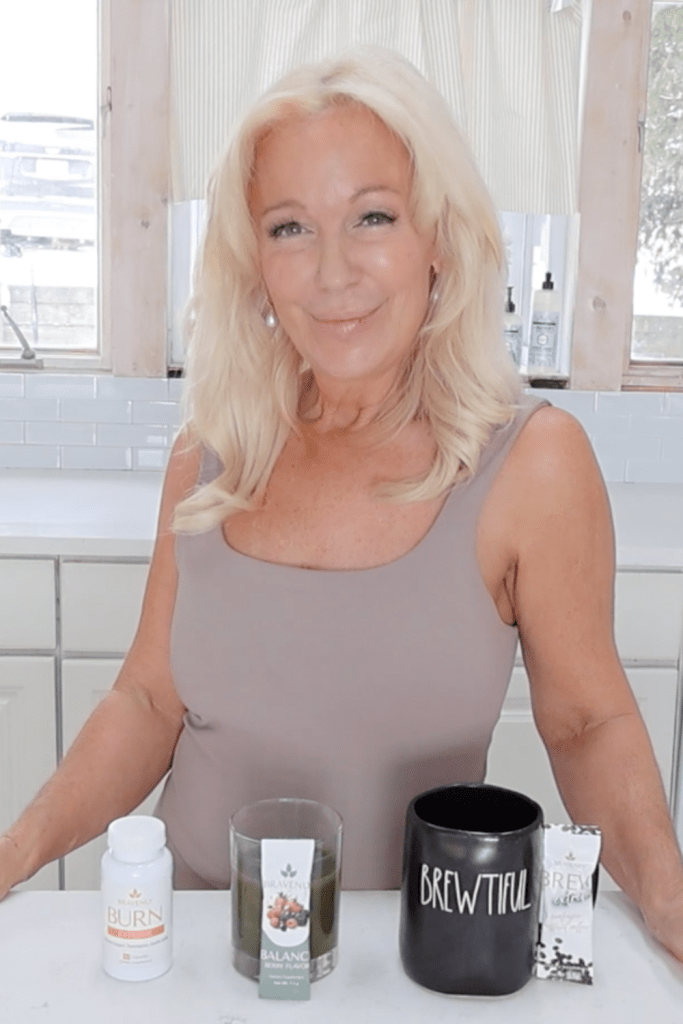
Before we get into everything—I want to show you exactly what I use, because I know you’re probably thinking:
👉 “Just tell me what actually works.”
I don’t rely on one product.
I use a simple, targeted system that supports the areas most women in midlife are actually struggling with:
- Calm → for stress, anxiety, and that “wired but exhausted” feeling
- Adapt → for brain fog, focus, and helping your body handle stress better
- Drive → for hormonal support, mood, intimacy, and feeling like yourself again
- Brew → adaptogen nootropic coffee for clean energy, mental clarity, and replacing that jittery coffee cycle
- Balance → to regulate blood sugar, curb cravings, and feel fuller quicker during meals
- Ignite → for metabolism support and helping my body actually burn instead of store
This isn’t about taking “more things.”
Now let me show you why this matters—and why what I tried before didn’t work.

🌿 What Adaptogens Are (Really)
Adaptogens are plant compounds that help the body adapt to stress.
From a physiological standpoint, they work primarily on the HPA axis (hypothalamic-pituitary-adrenal axis) — the interconnected hormone system that governs our stress response and controls cortisol production .
This matters deeply in midlife, because when estrogen and progesterone begin to fluctuate, cortisol becomes louder.
That rise in cortisol can affect:
- Sleep quality
- Blood sugar regulation
- Mood and anxiety
- Energy levels
- Fat storage (especially abdominal fat)
- Temperature regulation (hot flashes)
Here’s the distinction that changes the conversation:
Adaptogens do not replace estrogen or progesterone.
They help buffer, balance, and normalize cortisol output — the hormone that often amplifies menopausal symptoms when the body is under chronic stress.
Research shows adaptogens act as biological “buffers” — reducing excessive cortisol during stress while also supporting adrenal output during fatigue and low-energy states .
That dual action is what makes them uniquely helpful in perimenopause.
⚖️ Adaptogens vs. HRT — An Honest Comparison
HRT works by replacing declining hormones, and for many women it can be incredibly effective for:
✔ Severe hot flashes and night sweats
✔ Bone density protection
✔ Vaginal dryness and libido changes
✔ Significant quality-of-life improvement
Adaptogens work differently.
They do not override hormone production.
They do not force estrogen up or down.
Instead, they:
✔ Regulate the stress response
✔ Reduce excessive cortisol secretion
✔ Improve stress tolerance
✔ Support nervous-system balance
✔ Improve energy efficiency at the cellular level
✔ Reduce stress-driven symptom amplification
This is why adaptogens are often described in the research as “reinforcements during periods of high stress,” not replacements for medical therapy .
So the truth is nuanced — and empowering:
Adaptogens are not a biochemical replacement for estrogen or progesterone.
But they can be profoundly effective for women whose symptoms are being driven or worsened by cortisol dysregulation.
And that brings me to something personal.
🌿 Why I Personally Chose Adaptogens
I want to be very honest here, because I know many of you are quietly trying to decide what to do next.
I personally tried both traditional HRT and bioidentical HRT.
And for me?
I hated them.
They didn’t make me feel better.
They didn’t make me feel like myself.
And the side effects outweighed any benefit I experienced.
That does not mean HRT is wrong.
And it absolutely does not mean it won’t be life-changing for another woman.
It simply means it wasn’t the right solution for my body.
When I stepped back and looked at my symptoms through a cortisol lens, something clicked.
My issue wasn’t just declining estrogen — it was:
- Chronic stress
- An overworked nervous system
- Disrupted sleep
- Blood sugar instability
- A body stuck in fight-or-flight
According to the cortisol research, chronic stress exaggerates adrenal output and disrupts the HPA axis — which can magnify menopausal symptoms even when hormone levels alone don’t explain how bad you feel .
That’s when I chose adaptogen therapy.
Not because it was trendy.
Not because it promised a shortcut.
But because adaptogens support the stress systems that were actually driving my symptoms.
And for me?
It’s working.
I feel calmer.
I sleep better.
My energy is steadier.
My mood is more regulated.
And most importantly — I feel like myself again.
For me, adaptogens weren’t about doing less.
They were about lowering cortisol, stabilizing my stress response, and supporting my body instead of fighting it.

🤍 A Gentle (But Important) Disclaimer
This article — including my personal experience — is for education and conversation, not medical advice.
Adaptogens are not intended to replace medical care, hormone therapy, or guidance from your healthcare provider. Research makes it clear that while adaptogens are powerful tools for stress modulation, they work best as supportive reinforcements, especially during periods of chronic stress or hormonal transition .
Every woman’s body, medical history, and symptom profile is different. Decisions about HRT, supplements, or integrative care should always be made with a qualified medical professional who knows you….and actually treats you.
My goal is not to steer you away from HRT —
It’s to help you understand why supporting cortisol and the nervous system can change everything.
🌿 Adaptogen Categories — and Where Bravenly Fits
🧘♀️ Calming & Cortisol-Lowering Adaptogens
Ashwagandha, Holy Basil, Eleuthero, Schisandra
These herbs are shown to:
- Reduce stress perception
- Lower excessive cortisol output
- Improve sleep quality
- Calm the nervous system
Bravenly matches:
🌿 Balance Greens — includes ashwagandha, rhodiola, maca, and eleuthero to support stress resilience, mood, and daily balance
😌 Bravenly Calm — a comprehensive adaptogenic blend featuring ashwagandha, rhodiola, holy basil, schisandra, eleuthero, astragalus, maca, and ginseng to help regulate stress, improve mental clarity, and support a calmer, more balanced nervous system
🔋 Energy-Supporting (Without Cortisol Spikes)
Rhodiola, Schisandra, Panax Ginseng
These adaptogens:
- Improve mitochondrial efficiency
- Increase stress tolerance
- Support energy without overstimulation
- Reduce cortisol rise during exertion
Bravenly matches:
☕ Brew Adaptogen Nootropic Coffee — functional mushrooms + Holy Basil for calm, focused energy
🔥 Ignite — rhodiola and schisandra for adrenal stamina and motivation without burnout…and energy!
⚡ Bravenly Drive — includes maca root and panax ginseng to support natural energy, stamina, intimacy, and overall vitality while promoting hormonal balance…husbands are happy with this product!
🍄 Broad-Spectrum Stress Resilience
Functional Mushrooms, Astragalus
These compounds:
- Support immune-stress interaction
- Improve recovery from chronic stress
- Enhance cognitive resilience
Bravenly matches:
✨ Bravenly Adapt — a concentrated blend of functional mushrooms like Lion’s Mane, Reishi, Chaga, and Turkey Tail to support stress resilience, immunity, and mental clarity
☕ Brew Mushroom Coffee — daily mushroom support paired with sustained, focused energy
💛 Hormonal Balance + Vitality Support
Maca Root, Panax Ginseng, Saw Palmetto
These adaptogenic compounds:
- Support hormonal balance
- Improve physical vitality and stamina
- Enhance mood and overall well-being
- Support libido and sense of connection
Bravenly match:
💫 Bravenly Drive — an advanced adaptogenic blend designed to support energy, hormone balance, intimacy, and that overall “zest for life” that can feel diminished in midlife…husbands are happy with this product!
🧠 Stress + Mood + Nervous System Support
Ashwagandha, Rhodiola, Holy Basil, Passion Flower
These support:
- Emotional balance and mood regulation
- Reduced anxiety and overwhelm
- Improved mental clarity
- Restful sleep and recovery
Bravenly match:
🌙 Bravenly Calm — designed to calm the nervous system, ease high-stress moments, and support a more relaxed, steady state throughout the day and into the evening
🧬 Supportive (Not Core Adaptogen) Products
These support systems affected by cortisol but do not directly modulate the HPA axis:
- Gut Health Duo – Renew + Refresh: comprehensive digestive support – fix the gut to speed up weight loss + metabolism
- Reset — gut and detox pathway support
- Fit Fuel — protein, collagen, and metabolic support
- Hydrate — electrolytes + L-theanine for hydration and calm focus
- GOLD Immune-Skin Tea — inflammation and immune support
- Burn Extreme — blood sugar and metabolic support, appetite control
- Glow Collagen Gummies — skin, hair, and connective tissue support
- Drift Hot Cocoa – sleep support
🌿 Final Thoughts
Adaptogens are not hormone replacements.
They are system supporters.
They help calm the nervous system, stabilize energy, support mood, and reduce the stress burden that makes perimenopause feel so hard — whether you choose HRT, use it later, combine approaches, or decide it’s not right for you.
Midlife wellness is not about forcing your body into submission.
It’s about listening — and supporting it well.
And that’s the conversation I want us to keep having 🤍
📚 Sources & Further Reading
If you’d like to go deeper into the science and lived experience behind hormones, cortisol, stress physiology, and midlife wellness, these resources strongly informed my perspective:
- 📕 Next Level by Stacy Sims
https://amzn.to/3YhKK5a
An evidence-based look at how female physiology changes in midlife — especially around stress, exercise, recovery, and why “do more” stops working for women after 40. This book has THE BEST chapter explanation on the differences amongst HRT, Bioidentical HRT, Non-Hormonal Interventions, and Adaptogen Therapy. - 📗 The Perimenopause Diet by Emma Clarkson
https://amzn.to/3YLW49U
A practical guide to stabilizing blood sugar, reducing inflammation, and supporting hormones through food — without dieting or deprivation. This book is THE BEST PLAIN LANGUAGE explanation of perimenopause, menopause, and post-menopause. - 📘 The Perimenopause Cookbook by Emma Clarkson
https://amzn.to/4ayEygw
A real-life companion to the diet book, showing how nourishment (not restriction) can calm cortisol and support metabolic health in midlife. - 📙 The Cortisol Connection by Shawn Talbott
https://amzn.to/4qDvDzk
A foundational explanation of how chronic stress and cortisol dysregulation quietly drive fatigue, weight gain, sleep disruption, and mood changes — especially during hormonal transitions.
Midlife Posh Closet uses affiliate links within this site. Purchasing an item through a link from MidlifePoshCloset.com or Midlife Closet social media (Facebook, Pinterest, Instagram, TikTok, YouTube) may result in a commission. Merely clicking on a link does not result in a commission, but if an item is purchased as a result of the link, a commission is earned. If you have any specific questions about my disclosures or affiliate links, please feel free to contact me directly at val@midlifeposhcloset.com