
💌 SIGN UP FOR MY NEWSLETTER!
In my newsletters, I am share with you tips on how I’ve lost almost 30 POUNDS and the recipes I used to get there.
And it’s completely FREE..sign up HERE!
Watch on YouTube!
If you are in perimenopause or menopause and struggling with anxiety — or that constant wired, on-edge feeling — you aren’t alone.
And you are not the problem.
For years, I thought weight loss struggles, poor sleep, cravings, and anxiety in midlife were personal failures. A lack of discipline. A need to “try harder.”
I was wrong.
This Isn’t About Mental Strength
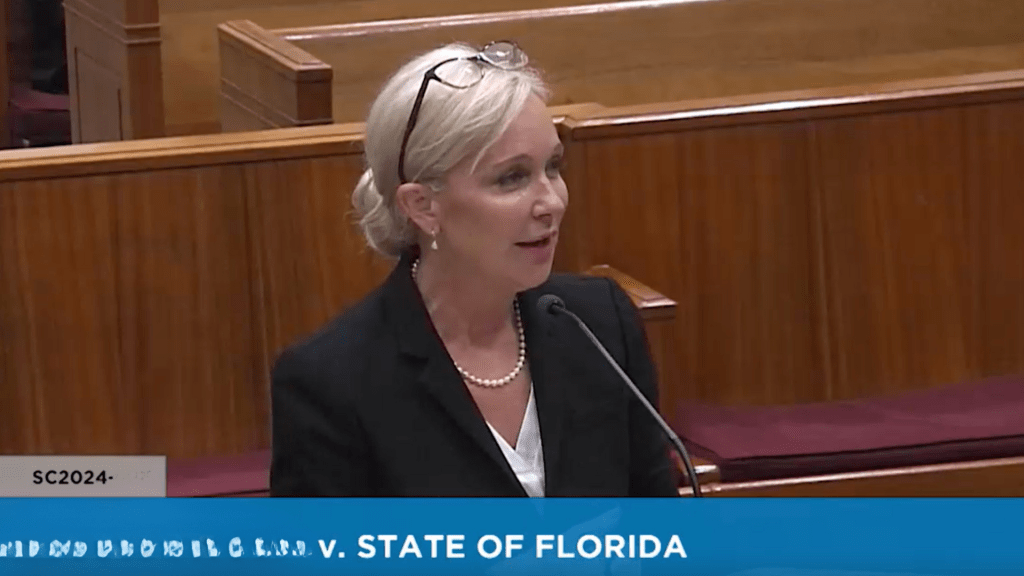
I’m a lawyer in the criminal justice system.
For more than 20 years, I’ve worked firsthand with cases most people never encounter outside of documentaries or headlines:
Autopsies.
Homicides.
Severe and horrific child abuse.
What you see on television is less than half of what we see in real courtrooms.
I’ve spent my career in high-stakes environments that demand composure, clarity, and emotional regulation under extreme pressure. I know how to compartmentalize. I know how to function in crisis. I know how to stay grounded when situations are objectively devastating.
So when anxiety showed up during perimenopause, I knew immediately:
This wasn’t about mental toughness.
This wasn’t weakness.
This wasn’t me suddenly “not being able to handle stress.”
It was physiological.
Hormonal changes altered how my nervous system processed stress — even stress I had been professionally trained to manage for decades.
And once I understood that, everything about weight loss, sleep, anxiety, and stubborn belly fat finally made sense.

What Perimenopause Did to My Nervous System
Until perimenopause, my nervous system was relatively stable.
I could relax.
I could sit still.
I could watch TV without my body feeling uncomfortable.
Then, almost overnight, things changed.
I noticed:
- I couldn’t sit still
- Watching TV made me restless or uneasy
- I needed to stay busy to keep anxiety from creeping in
- Stillness felt uncomfortable instead of restorative
- My body stayed in a constant low-grade alert mode
I wasn’t suddenly an anxious person.
My body was responding to hormonal change — particularly declining estrogen and progesterone, which play a direct role in nervous system regulation, blood sugar stability, and stress response.

Why Weight Loss Can’t Happen in Fight-or-Flight
When the nervous system is dysregulated — which is incredibly common in perimenopause and menopause — the body prioritizes survival, not fat loss.
In a fight-or-flight state:
- Cortisol stays elevated
- Blood sugar becomes unstable
- Insulin sensitivity drops
- Digestion slows
- Sleep becomes fragmented
- Cravings increase
- Belly fat becomes stubborn
The body isn’t broken.
It’s responding to perceived stress created by hormonal shifts.
And no amount of eating less or exercising more will override that signal.
The Question That Changed Everything
Instead of asking:
“Why is this happening to me?”
I started asking:
“What does my nervous system need right now?”
That was the turning point.
I stopped trying to overpower my body and started supporting it.
That meant:
- Prioritizing nourishment over restriction
- Creating predictability instead of chaos
- Supporting blood sugar daily
- Reducing internal stress signals
- Regulating my nervous system instead of ignoring it
And one of the biggest missing pieces for me was vagus nerve support — something no one ever explained to me in midlife.

The Missing Link: The Vagus Nerve
The vagus nerve is the primary pathway of the parasympathetic nervous system — the system responsible for rest, digestion, and calm.
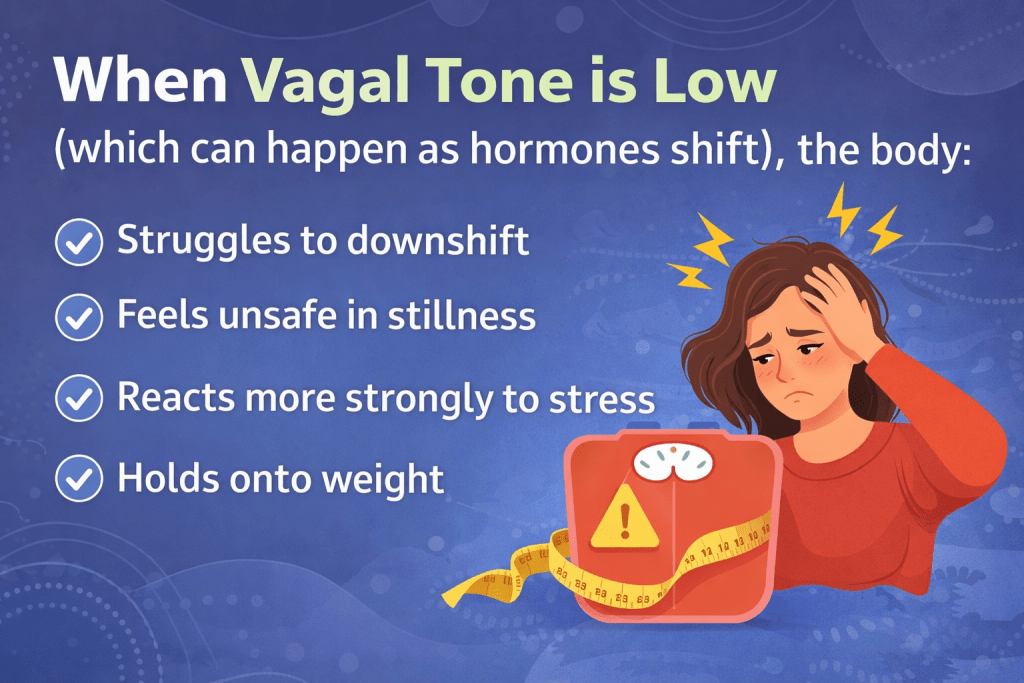
When vagal tone is low (which can happen as hormones shift), the body:
- Struggles to downshift
- Feels unsafe in stillness
- Reacts more strongly to stress
- Holds onto weight
That was me.
My nervous system didn’t know how to relax anymore — even when I wanted it to.
This is where targeted nervous system support became essential.
How pHix Changed My Relationship with Anxiety
One of the most impactful tools I added was pHix.
pHix supports the gut–brain–vagus nerve axis, which is critical because a significant portion of calming neurotransmitters are produced in the gut.
What I noticed wasn’t dramatic or instant — it was subtle and profound.
Over time:
- My baseline anxiety softened
- My nervous system didn’t react as sharply
- I could sit still again
- Watching TV no longer made me feel uneasy
- My body stopped feeling like it needed to stay “on” all the time
I didn’t feel sedated.
I felt regulated.
And that distinction matters.
Why Nervous System Support Has to Be Layered
Here’s something I learned quickly:
Regulation isn’t a one-time fix.
During perimenopause and menopause, the nervous system is constantly processing hormonal fluctuations, blood sugar changes, sleep disruption, and stress.
Support has to be consistent and layered.
For me, that looked like:
- pHix for gut-brain and vagal support
- Bravenly Balance Greens to reduce inflammation and support digestion (which directly impacts cortisol and estrogen metabolism)
- Bravenly Adapt to combat brain fog and support mental focus without jitters
- Bravenly Drift at night to support relaxation and sleep without forcing sedation
None of these were about “weight loss.”
They were about creating safety in the body.

Blood Sugar, Sleep, and Stress Are Nervous System Issues
One of the biggest surprises for me was realizing how deeply blood sugar instability affects the nervous system.
Blood sugar spikes and crashes are interpreted by the body as stress.
When blood sugar crashes → cortisol spikes → anxiety increases.
When blood sugar stabilizes → the nervous system calms.
This is why I focus so heavily on:
- Balanced meals
- Protein at bedtime
- Reducing late-night blood sugar drops
Sleep works the same way.
When sleep improves, nervous system regulation improves the next day — and everything builds from there.
Nothing exists in isolation.
What Changed Once My Nervous System Felt Safe
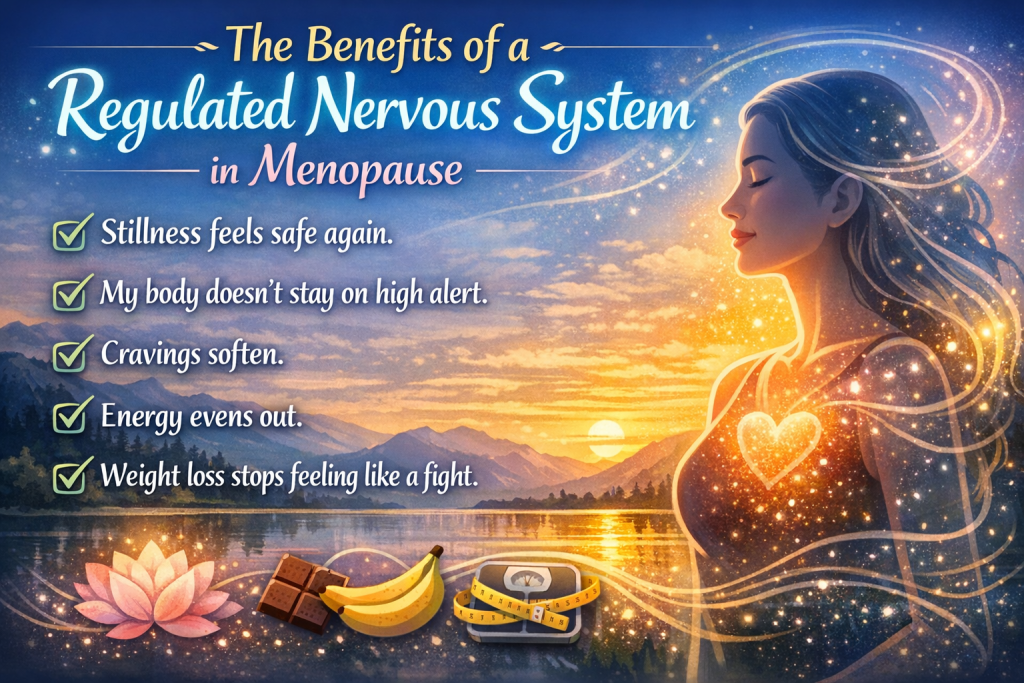
Once my nervous system settled, everything else followed:
- Deeper sleep
- Fewer cravings
- Reduced belly inflammation
- More stable energy
- A calmer relationship with food
- Weight loss that no longer felt forced
Not because I pushed harder.
But because my body stopped resisting.
Weight loss became a byproduct, not a battle.
The Midlife Truth I Live By Now
Perimenopause taught me something I wish more women were told sooner:
You don’t fight your body through this transition.
You support it.
When you calm the nervous system, the body stops sounding alarms.
And when the alarms stop, healing — including weight loss — becomes possible.
A Gentle Note on Medical Care
What I’m sharing reflects my personal experience and a nervous-system-first approach that many women find helpful during perimenopause and menopause.
This is not medical advice and does not replace care from a qualified healthcare provider.
Tools like pHix, Balance Greens, Reset, and Drift are foundational supports — not replacements for medical care or individualized treatment.
You are not failing.
You are responding to change.
And with the right support, your body can find its way back to safety.
Midlife Posh Closet uses affiliate links within this site. Purchasing an item through a link from MidlifePoshCloset.com or Midlife Closet social media (Facebook, Pinterest, Instagram, TikTok, YouTube) may result in a commission. Merely clicking on a link does not result in a commission, but if an item is purchased as a result of the link, a commission is earned. If you have any specific questions about my disclosures or affiliate links, please feel free to contact me directly at val@midlifeposhcloset.com